Associate Words: Solitaire
- 4.8
- Rating
- 1.00M
- Installs
- Free
- Price
 Analysis by App-foxy
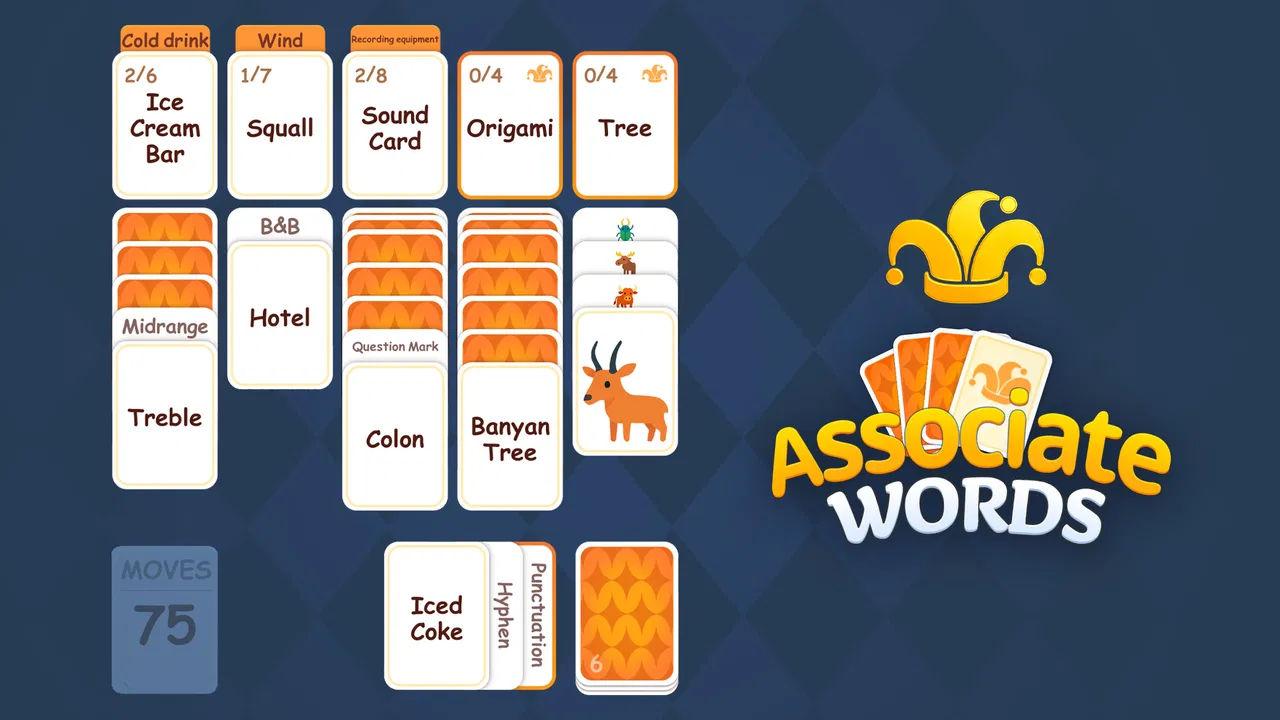
I approached Associate Words: Solitaire expecting a light word game, but its card-based format gives the familiar association puzzle a more deliberate rhythm. Instead of racing through a traditional crossword or trying to build a long word in a letter game, I look at the available cards, search for a relationship between words, and make a matching choice. That small change makes each round feel more like sorting ideas than filling blanks.
It is a free word game from Astrasen Global, rated for Everyone, and it runs on Android devices using version 6.0 or later. The game has reached over 500 thousand installs and holds a 4.9 average from around 10 thousand ratings, which suggests that its simple premise has found a receptive audience. I would not treat those figures as a guarantee that every player will enjoy it, but they do fit my impression: this is an accessible game designed for short, repeatable sessions rather than a demanding competitive challenge.
The basic appeal is easy to understand. You see word cards, consider their meanings, and connect the ones that belong together. The solitaire influence makes the experience feel structured, while the association element keeps it from becoming a purely mechanical card exercise. The best way to play is to treat every move as a small sorting problem, not as a test of how quickly you can tap.
You May Also Like

 Blood Strike: 2.5 Anniversary
Blood Strike’s Loadouts Turn Every Drop Into a Tactical Gamble
A close look at Blood Strike’s custom loadouts: how fast access to signature weapons reshapes its battle royale rhythm, rewards preparation, and narrows the gap between fights.

 Pandora - Music & Podcasts
Pandora’s Music Is Easy to Start, but Harder to Recover
Pandora’s strength is its low-effort path from a seed to a station. Its weak spot is how much confidence it asks you to place in connection, setup, and quiet recovery.

 8 Ball Pool
 Is Built on Rivalries, Rematches, and Routine
A close look at the rivalries, rematches, shared routines, and unanswered safety questions that turn a quick pool match into a persistent mobile community.

 Samsung Music
’s Quiet Strength Is Playing What You Already Own
Its reach comes less from spectacle than from dependable access to a personal library. That simplicity is both the app’s strongest retention engine and its ceiling.

 AccuWeather: Weather Radar
AccuWeather Review: A Quick, Clear Forecast for Everyday Decisions
For everyday plans, the best forecast is the one you can understand quickly. AccuWeather makes rain timing, radar, and local conditions easy to act on, with a few trade-offs.

 Hill Climb Racing
Why Hill Climb Racing Still Turns Crashes Into One More Run
A tiny car, a bumpy hill and one more upgrade: Hill Climb Racing keeps resurfacing because its simple chaos makes every near-miss feel personal.
More From Our News Desk
View All News


How I settled into the everyday workflow
My normal session starts with a quick scan rather than an immediate move. I read all the visible words and identify the clearest relationship first. Sometimes two cards are connected by category, sometimes by a familiar phrase or shared idea, and sometimes the link becomes apparent only after I remove a more obvious pair. That first scan matters because an early guess can make the remaining layout harder to read.
For a short break, the game fits neatly into the gaps between ordinary tasks. I can play while waiting for a coffee, during a commute break, or when I want something more active than scrolling but less demanding than a full game session. The lack of a complicated opening routine is one of its practical strengths. I can start thinking immediately instead of spending time learning a large rule set.
A useful habit is to separate certainty from possibility. I mentally group cards into three levels: a pair that is almost certainly related, a pair that seems plausible, and words that have no useful connection yet. I usually play the strongest relationship first, but I hold back when two possible matches share a word with a third card. This prevents me from spending a good option simply because it appeared first.
That approach also makes the game friendlier for casual players. You do not need a large vocabulary to begin, because many associations rely on everyday language. At the same time, a player who enjoys nuance can look for less direct links and question whether a tempting match is actually the intended one. The game’s appeal comes from that middle ground: it is approachable without being completely thoughtless.
Why the card format changes the pace
Compared with a conventional crossword, this format removes the pressure of solving a clue with a precise spelling. Compared with a word search, it asks for meaning rather than visual scanning. Compared with a standard solitaire game, the important action is not arranging suits or building numerical sequences. The cards give the session a visual structure, but the real work happens in the relationships among words.
I found that difference especially useful when I wanted a calm game that still kept my attention moving. A crossword can become frustrating when one clue blocks the entire grid. A letter game can encourage trial and error. Here, I can usually keep examining the remaining cards and change my interpretation without feeling that the whole round has collapsed.
There is a trade-off, though. Players who want a deep vocabulary challenge, a timer-driven contest, or a large strategic system may find the experience too gentle. Its satisfaction comes from recognizing connections and making clean progress, not from mastering a complex economy or competing against other people. I would recommend it to someone who likes wordplay with a visual, puzzle-like flow, but not as a replacement for a serious dictionary game.
Settings I would check before settling in
My first practical recommendation is to inspect the available settings before forming an opinion about the game. In a word puzzle, sound, vibration, notifications, and display behavior can affect the experience more than expected. I prefer a quiet setup when playing in public, while a player at home may enjoy feedback that confirms a selection. Checking these controls early helps avoid mistaking an unwanted interruption for a problem with the core game.
I also pay attention to how the cards are presented and whether the screen remains comfortable during longer sessions. A word association game depends on reading, so anything that makes the text difficult to distinguish can turn a relaxed puzzle into unnecessary eye strain. I would adjust the device’s display comfort options if needed and keep the game at a readable size rather than forcing myself to play quickly.
Another setting-related habit is to review notification behavior. I do not want a casual puzzle asking for attention while I am working or eating. If the device offers notification controls, I would use them to keep the game in its proper place: available when I choose it, but not competing with messages or appointments. This is a small point, yet it makes a difference for an app intended for frequent short visits.
Players should also remember that the game is free to download but includes in-app purchases ranging from $0.99 to $99.99 per item. I would check purchase controls on the device before handing it to a child, even though the content rating is Everyone. The age rating describes the suitability of the game’s content; it does not remove the need for sensible purchase protection.
The current version is 1.181, and the minimum operating system is Android 6.0. Those details make the compatibility question fairly straightforward for Android users: check the device version before installing, then keep expectations realistic about performance on older hardware. I would not upgrade a phone solely for this game, but a supported device should be the starting point for a smoother reading experience.
Repeatable patterns that make solving faster
Speed in this game does not come from tapping faster. It comes from reducing the number of interpretations you carry at once. I begin with concrete categories: animals, foods, places, objects, or actions. If a group appears, I mark it mentally and then look for the card that would make the relationship most natural. This is more reliable than chasing clever wordplay from the first second.
My second pattern is to look for grammatical or phrase-based connections after checking literal categories. A word may not belong to a group of objects, but it may complete a familiar expression or pair naturally with another word. This is where the game becomes more interesting than a basic matching exercise. The strongest association is not always the most obvious visual pair; it is the one that leaves the remaining cards with sensible relationships.
I also use a “remaining board” check before confirming a questionable match. If a possible pair looks good but leaves several unrelated words, I reconsider it. If another choice creates two or three cleaner groups, that choice is usually safer. This is a particularly useful habit for players who tend to lock onto the first connection they notice.
When I am stuck, I stop trying to solve every card simultaneously. I choose one word and list its possible meanings in my head. Is it an object, a verb, a title-like term, a place, or part of a phrase? Then I compare those meanings with the visible cards. This focused method is less tiring than scanning the entire layout repeatedly and often exposes a relationship that was hidden by a familiar interpretation.
A further improvement is to slow down after a successful move. Removing one pair changes the context of everything left on screen. I take a fresh look instead of assuming that the next move uses the same kind of association. In practice, this prevents a common mistake: carrying the logic of the first pair into a second group where it no longer applies.
Useful routines for different kinds of players
If I had only a few minutes, I would play one round with a strict no-rush rule. The goal would be to notice which words I misread and why. This turns a spare moment into a small vocabulary exercise without making the game feel like studying. It is also a good way to decide whether the association style suits me before spending money on any optional purchase.
For a longer session, I would take a brief pause between rounds instead of immediately repeating the same solving pattern. Word association games can encourage tunnel vision, especially when the player expects every puzzle to use the same type of connection. A reset helps me approach the next layout with fewer assumptions.
Families can use the game as a conversation starter, although I would keep purchase protection enabled on shared devices. Two people can discuss why a pair seems related without turning the session into a formal competition. That works particularly well for younger players because it rewards explanation and flexible thinking rather than only speed. Since the rating is Everyone, the content is positioned for a broad audience, but individual reading ability will still determine how comfortable a child feels.
Older Android users may appreciate the straightforward format because it does not demand the reflexes of an action game. However, readability becomes more important as sessions lengthen. I would play with a clear screen, avoid unnecessary background distractions, and use the game in short intervals if reading small cards becomes tiring.
Where the design reaches its limits
The same simplicity that makes the game inviting can limit its long-term appeal. There is no indication in the core concept that it is trying to become a full word-learning course, a competitive ladder, or a narrative adventure. If I want detailed definitions, pronunciation practice, or a measurable study plan, I would choose a dedicated language-learning tool instead. If I want a more strategic solo card game, traditional solitaire would offer a clearer ruleset.
Association puzzles can also feel subjective. A player may see a perfectly reasonable connection that is not the one the puzzle expects. That is not necessarily a flaw in one individual round, but it can be frustrating for people who prefer rules with only one mathematically correct answer. I would approach the game with a willingness to think in terms of intended relationships, not just defend every possible interpretation.
Another limitation is that casual wordplay does not automatically provide endless variety. The experience depends heavily on the quality and freshness of the word relationships. If I play for too long, the relaxed discovery can become repetitive. My solution is to use it as a small daily or occasional activity rather than forcing a marathon session. It works better as a dependable mental break than as my only game.
In-app purchases are another point to consider. The game is free, which makes trying it easy, but the listed purchase range is wide enough that I would not tap through purchase screens casually. I would decide first whether the free experience already meets my needs. For many players, the sensible approach is to enjoy the basic sessions, learn the game’s rhythm, and only then consider whether an optional item genuinely improves the experience.
I would also skip it if my priority is multiplayer interaction. The appeal here is personal concentration and word recognition, not social competition. Likewise, people who dislike reading on a phone or who want constant action will probably be happier with another genre. The game asks for patience and interpretation, so its calm pace is either a strength or a weakness depending on what I want at that moment.
My verdict after making it a habit
Associate Words: Solitaire works best when I use it deliberately: scan first, separate certain matches from uncertain ones, check how each move affects the remaining cards, and pause when my thinking becomes repetitive. Those habits make the game feel more intelligent than its short description suggests, without pretending that it is a complex strategy title.
I like the balance between a familiar card layout and word-based reasoning. It is easy to begin, suitable for brief sessions, and flexible enough to reward players who look beyond the first obvious match. The strongest practical use is as a quiet, low-pressure break for someone who enjoys language but does not want a full crossword or a demanding competitive app.
My recommendation is more measured for advanced word-game players. If you want definitions, progression systems, strict competitive scoring, or deep solitaire strategy, another option will serve you better. If you want a free starting point for relaxed association puzzles, this is a convincing choice, provided you are comfortable with the possibility of subjective connections and optional purchases.
Overall, Astrasen Global has built a focused experience rather than an overloaded one. The 4.9 average and broad install reach are encouraging, but my own reason to return is simpler: each round asks me to look at ordinary words from a slightly different angle. For a calm daily puzzle that rewards careful grouping more than quick reactions, this is worth trying.
FAQs for Associate Words: Solitaire
01What is Associate Words: Solitaire and how does it differ from traditional solitaire games?
Associate Words: Solitaire is a unique twist on the classic solitaire game, incorporating word association challenges. Unlike traditional solitaire, where your primary task is to organize cards into sequences, this game requires players to match words and solve puzzles, adding an educational layer to the classic card game experience.
02Is Associate Words: Solitaire suitable for all age groups?
Yes, Associate Words: Solitaire is designed for players of all ages. Its blend of card strategy and word puzzles offers educational benefits for younger players while providing engaging gameplay for adults. The game’s difficulty scales, which means it can challenge both novice and experienced puzzle enthusiasts.
03Does Associate Words: Solitaire require an internet connection to play?
Associate Words: Solitaire can be played offline, making it a perfect companion for on-the-go entertainment. However, some features, such as leaderboards and daily challenges, require an internet connection to function. Playing offline won't hinder your ability to enjoy the core game experience.
04Are there in-app purchases or ads in Associate Words: Solitaire?
Yes, Associate Words: Solitaire includes both in-app purchases and ads. Players can purchase additional features or remove ads for a more seamless experience. The game is designed to be enjoyable without spending money, but these options are available for those who wish to enhance their gameplay.
05How can players track their progress and achievements in Associate Words: Solitaire?
Players can track their progress through an in-game profile that records achievements, high scores, and completed challenges. The game offers various milestones and rewards for players to unlock, encouraging continued play and providing a sense of accomplishment as you improve your skills.
Pros
- Engaging solitaire gameplay with a twist.
- Variety of challenges keeps it fresh.
- User-friendly interface for easy navigation.
- Offline mode available for play anytime.
- Regular updates with new features.
Cons
- Ads can be intrusive during gameplay.
- Limited free hints available per day.
- Some levels feel repetitive over time.
- In-app purchases can be pricey.
- Occasional bugs in older devices.

Associate Words: Solitaire
Gallery